Pathways is a breeder-friendly veterinary clinic in Williamsville, New York, and canine reproduction is what we are best known for. Breeders travel to us from across Western New York for ovulation timing, artificial insemination, frozen semen work, and planned C-sections — and Dr. Claudia Gray has produced litters using frozen canine semen preserved for more than twenty-five years as a Certified Zoetis Freezing Center.
A veterinary team that speaks breeder
If you have ever tried to explain a progesterone curve, a stud contract, or an OFA submission to a general-practice veterinarian who does not do reproductive work, you already know why breeders drive past several clinics to get here. You should not have to teach your own veterinarian your program.
Whether you are producing Best in Show conformation dogs, performance dogs, or family companions, our reproductive veterinarians understand the commitment behind it. We are here to keep your whelping boxes full of healthy puppies and happy dams, and your stud dogs thriving and preserved for the future.
Ovulation timing and progesterone testing
Getting the breeding date right is the single highest-leverage thing in a breeding program, and it is where most missed litters are actually lost. We run in-house, same-day progesterone testing using Enzyme Linked Fluorescent Assay, so you get a number the same day rather than waiting on an outside laboratory while the window closes.
By knowing precisely when the bitch ovulates, we can breed during her most fertile period — which improves conception rates and litter size, and matters enormously when you are working with shipped chilled semen or with frozen, where the window is measured in hours rather than days.
Artificial insemination: vaginal, TCI, and surgical
When natural breeding is not possible or not appropriate, we offer the full range of artificial insemination. Vaginal AI for fresh semen. Transcervical insemination — TCI — which places semen directly into the uterus without anesthesia, with a success rate greater than ninety percent. And surgical AI where frozen semen makes it the right call. Mavic catheters are available.
Which technique we recommend depends on the semen you are working with, the bitch, and the timing. We will tell you honestly which one gives this breeding its best chance, including when the honest answer is to wait for the next cycle.
Frozen semen and our Certified Zoetis Freezing Center
As a Certified Zoetis Freezing Center, we collect, evaluate, freeze, and store canine semen — which means a stud dog’s genetics can outlive him by decades. Dr. Gray has produced litters from semen frozen more than twenty-five years earlier, which is a fair summary of why this work matters to a serious breeding program.
For stud dog owners we also provide prostate evaluation, semen collection and analysis, semen cultures, testicular biopsies, and digital records of every collection. We understand the pressure that sits on a popular stud, and part of our job is protecting his future.
Chilled semen shipping, handled properly
We ship fresh chilled semen with FedEx pick-ups until 6pm and local drop-off until 8pm, using Zoetis Fresh Express and Minitube ChillGuard extenders, with full analysis included. Bitch owners can pay by phone, so a shipment is never held up by paperwork between two parties who have not met.
Small logistics like these are the difference between a breeding that happens and one that misses by a day.
Pregnancy diagnosis and puppy counts
Twenty-eight days after ovulation we ultrasound the uterus to confirm pregnancy, visualise fetal heartbeats, and give an approximate puppy count. One week before the due date we take a radiograph, which shows the exact number of fetuses.
That final count is not a nicety — it is a safety measure. Knowing there are seven puppies rather than an estimated five is what tells everyone in the room, at two in the morning, that whelping is not finished.
Planned C-sections and whelping support
A planned cesarean section, timed from initial ovulation and progesterone levels, is a very different event from an emergency C-section at the end of a long, failing labour. Timing it properly is how you protect both the dam and the litter.
Our bitches recover smoothly without external sutures, puppies are delivered into a warm, oxygen-rich environment by trained veterinary staff, and families are typically home within one to two hours. For breeds where dystocia is common — brachycephalics especially — planning the date rather than waiting for trouble is simply better medicine.
Health clearances, radiographs, and neonatal care
Our digital radiography allows timely OFA hip and elbow evaluations, and those films can often be taken without sedation thanks to gentle, precise positioning. PennHIP and SV/WUSV submissions do require sedation, because both schemes depend on positioning that cannot be achieved safely or accurately in an awake dog. Either way we are committed to sending the best possible representation of your dog, because a badly positioned film can cost a dog a grade it did not deserve.
We also perform a range of other official clearances in house: thyroid, basic cardiac, patellas, dentition, and radiographs of the shoulder, spine, and trachea. The only clearances we do not offer are the ones that require a specialist — eye certification and advanced cardiac — and we will point you to the right referral for those.
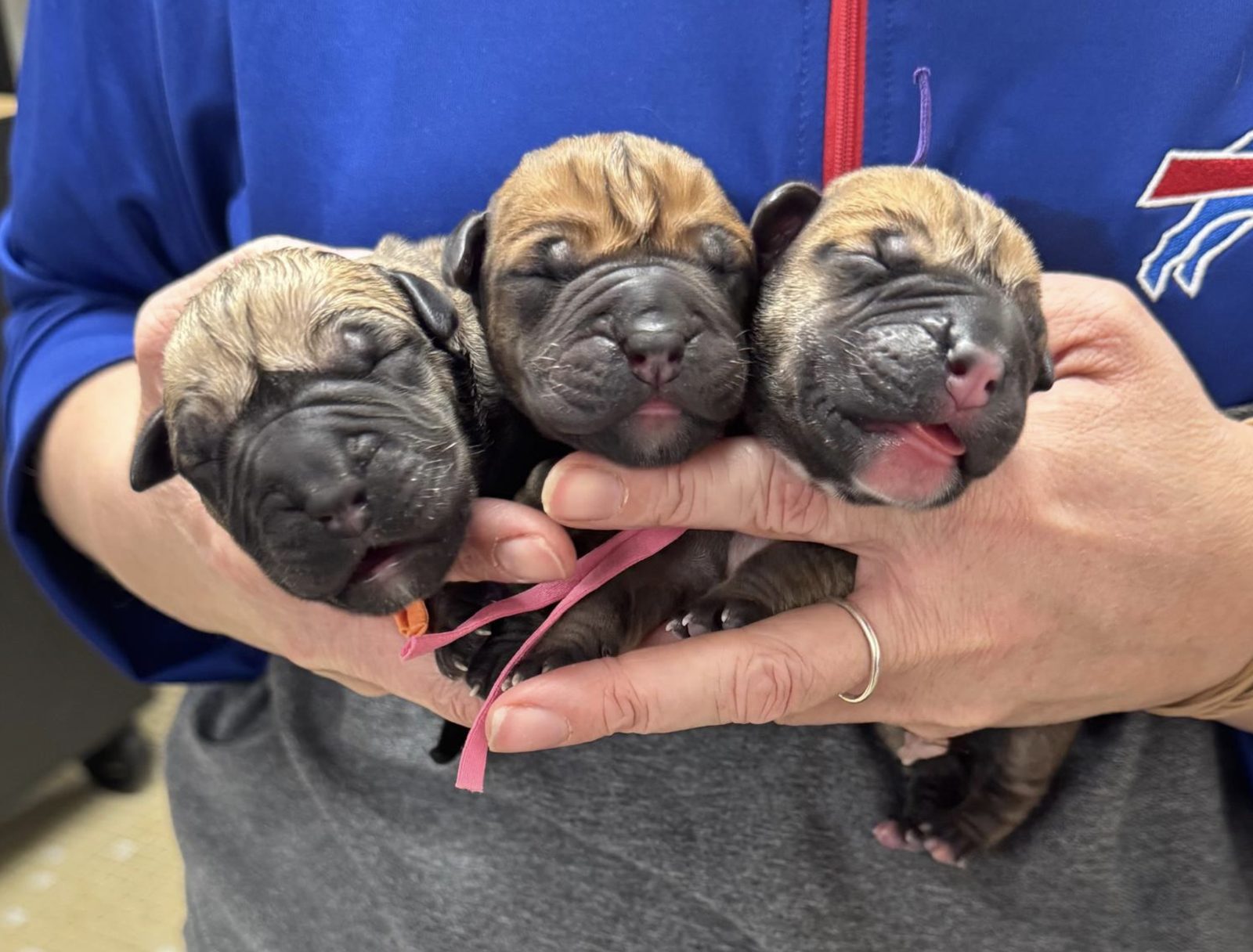
Before breeding, dams receive a full physical examination, parasite screening, brucellosis testing, appropriate immunisations, and nutritional counseling. Afterwards, our neonatal and pediatric care covers tube feeding, plasma administration, and antibiotics where needed. Your newborn puppies represent your past, present, and future, and we treat them that way.
Common questions
Where can I find a canine reproductive veterinarian near Buffalo, NY?
Pathways Animal Hospital in Williamsville, New York provides full canine reproductive services to breeders across Western New York, including same-day progesterone testing, transcervical and surgical artificial insemination, frozen semen collection and storage as a Certified Zoetis Freezing Center, pregnancy ultrasound, and planned C-sections. Call 716.936.8387.
How often should progesterone testing be done to time a breeding?
Testing usually begins early in the heat cycle and repeats every one to two days as values rise, so ovulation can be pinpointed rather than estimated. Because we run progesterone in-house by ELFA with same-day results, timing decisions can be made the same day — which matters most with chilled or frozen semen, where the fertile window is narrow.
What is transcervical insemination (TCI) and how successful is it?
TCI places semen directly into the uterus through the cervix using endoscopic guidance, without anesthesia. It is well tolerated, can be repeated, and in our hands has a success rate greater than ninety percent. It is often the preferred technique for chilled semen and for bitches where vaginal insemination has not produced a litter.
When can pregnancy be confirmed in a dog?
Ultrasound at around 28 days after ovulation confirms pregnancy and shows fetal heartbeats, along with an approximate puppy count. An accurate count requires a radiograph about a week before the due date, once the fetal skeletons have mineralized — that exact number is an important safety check during whelping.
Why choose a planned C-section instead of waiting?
A planned cesarean is scheduled from ovulation timing and progesterone values, so surgery happens on a healthy dam before a long or obstructed labour compromises her or the puppies. It is particularly recommended for breeds prone to dystocia. Emergency C-sections, by contrast, follow hours of failing labour and carry considerably more risk.
How long can frozen dog semen be stored and still work?
Properly frozen and stored canine semen remains viable for decades. Dr. Gray has produced litters using semen preserved for more than twenty-five years. As a Certified Zoetis Freezing Center we handle collection, evaluation, freezing, and long-term storage, which allows a stud dog’s genetics to remain available long after his breeding career.
Do OFA, PennHIP, or SV/WUSV x-rays require sedation?
It depends on the scheme. OFA hip and elbow films can often be taken without sedation using careful, gentle positioning, which breeders frequently tell us is unusual. PennHIP and SV/WUSV both do require sedation, because each depends on precise positioning that cannot be achieved safely or accurately in an awake dog. In every case correct positioning is what matters most, since a poorly positioned film can produce a grade that does not reflect the dog.
Which health clearances can you do in house?
We perform OFA hip and elbow radiographs, PennHIP evaluations, and SV/WUSV international submissions, along with thyroid, basic cardiac, patellas, dentition, and shoulder, spine, and trachea radiographs. The only clearances we do not offer are those that require a specialist — eye certification and advanced cardiac — for which we are glad to refer you.
Do you work with breeders who are not existing clients?
Yes, and no referral is needed. We do ask for a current annual examination with us for every breeding dog, and a breeding soundness examination for each cycle you intend to breed on — each time, not once a year. Vaccines and parasite screening should be current, and we expect health testing appropriate to the breed. We would also like to look after your dogs generally rather than only their reproductive work, because continuity matters in a breeding program. Call 716.936.8387 to talk it through.
References & further reading
The guidance on this page follows current veterinary consensus. These are the sources behind it, if you would like to read further.
- Veterinary reproduction and theriogenology — Society for Theriogenology
- Hip and elbow evaluation requirements — OFA
- Breeder resources and requirements — AKC
- Management of reproduction in dogs — Merck Veterinary Manual