
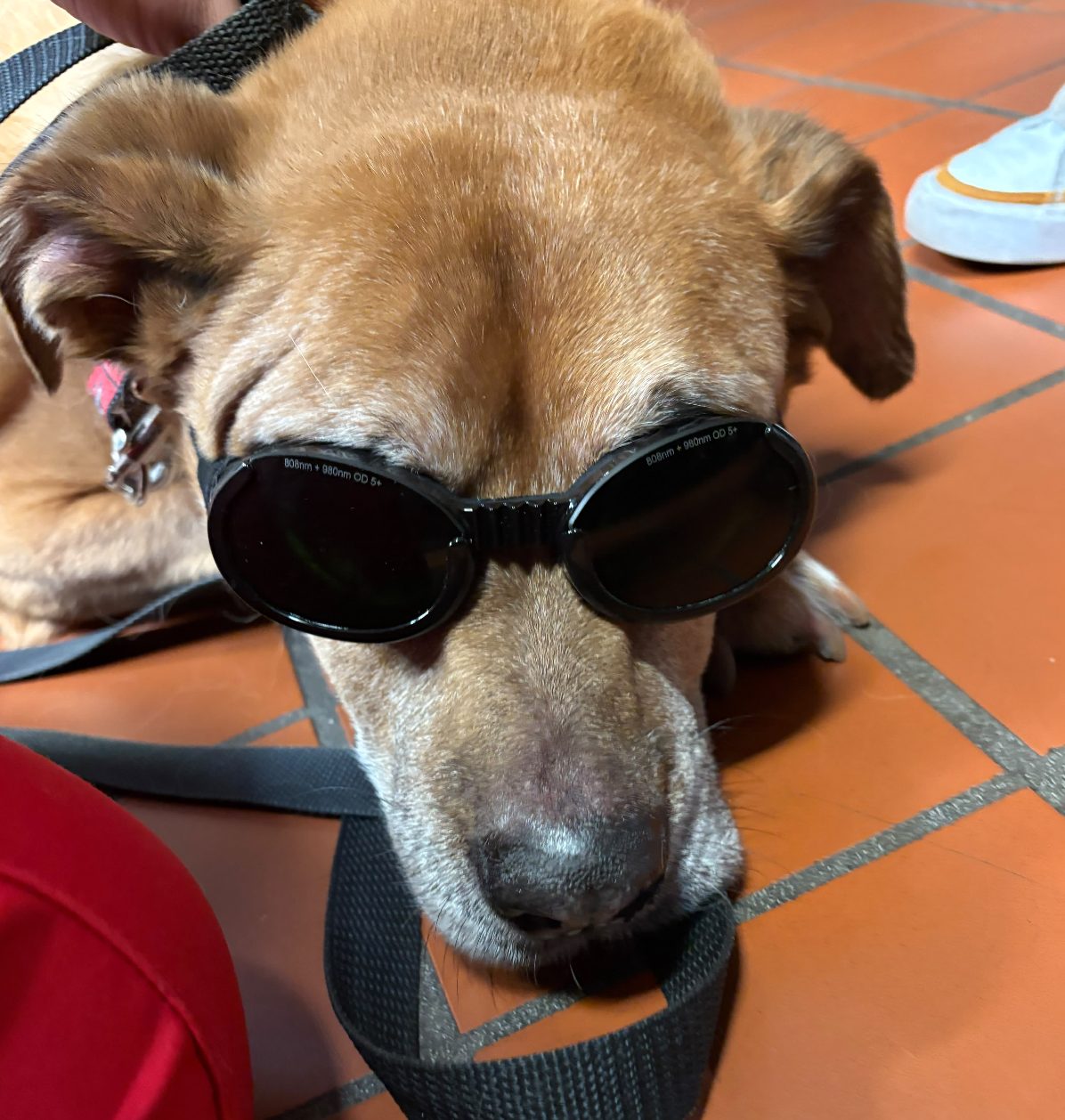
Platelet-rich plasma (PRP) therapy is a regenerative treatment for arthritis, joint pain and soft-tissue injuries in dogs. We draw a small amount of your dog's blood, concentrate the platelets and their healing growth factors in our in-house system, and inject that plasma directly into the affected joint, all during one office visit. Our doctors and technicians completed hands-on training in November 2026, and PRP is available now at 6543 Main Street, Williamsville, minutes from Buffalo.
PRP at a glance
What is platelet-rich plasma?
Platelets are the cells in blood that rush to an injury. They carry a payload of proteins called growth factors, which recruit the body's repair cells to the damaged area, clear away dead and injured tissue, and switch off the inflammation that causes pain. PRP is simply a sample of your dog's own blood with those platelets concentrated several times over, so the injured joint receives far more of its own healing signal than it ever would on its own.
Because PRP is injected straight into the source of the pain rather than swallowed and carried around the whole body, it is a targeted treatment. Nothing passes through the liver or kidneys, there is nothing to give at home, and because it comes from your own dog there is no risk of rejection or allergy to the plasma itself.
What PRP can treat
Regenerative medicine helps where the body's own repair response needs a push. In dogs, PRP is used most for:
Osteoarthritis in the hips, knees (stifles), elbows, shoulders and hocks, including the arthritis that follows years of hard work or play
Partial cruciate ligament tears and strains, and recovery after cruciate surgery
Tendon injuries such as shoulder and biceps tendinopathy in active and sporting dogs
Ligament sprains and muscle strains that keep flaring up
Chronic soft-tissue injuries that have not healed with rest and medication
Certain spinal conditions, assessed case by case
How a PRP treatment works at Pathways
An exam and a recommendation
Your veterinarian examines your dog, reviews X-rays or other imaging where they are needed, and confirms that PRP is the right choice for the joint or injury in question. If something else would serve your dog better, we will say so.
A small blood draw
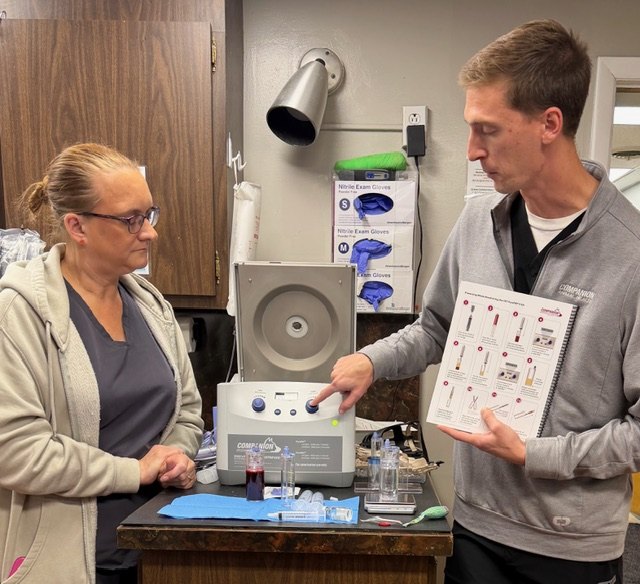
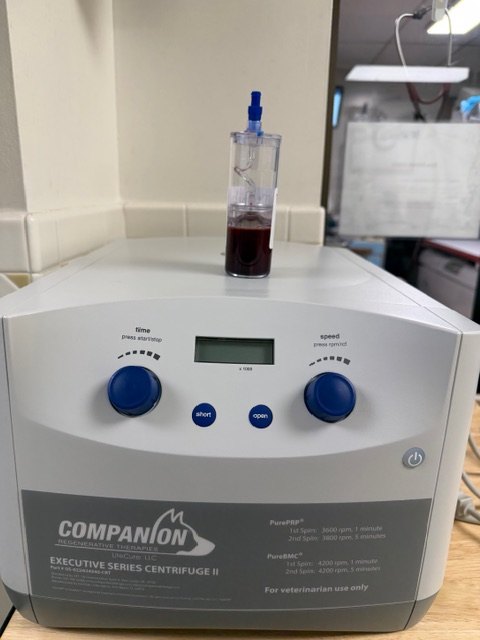
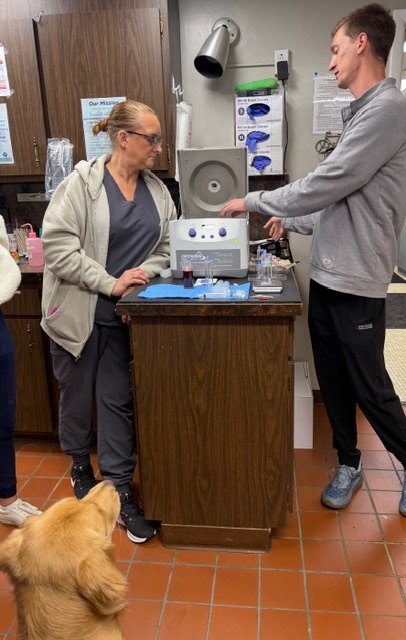
We take a small sample of your dog's own blood and spin it in our in-house system, which separates and concentrates the platelets and their growth factors into a small volume of plasma in a matter of minutes.
Injected during the same visit
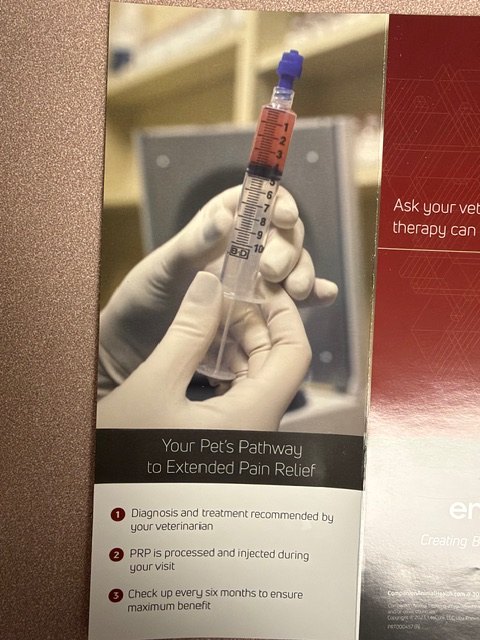
The PRP is injected directly into the affected joint, and into the matching joint on the opposite leg, which has quietly been doing more than its share. Dogs with several arthritic joints can have them all treated in the same session.
Paired with laser therapy
We pair PRP with Companion laser therapy, which calms inflammation and speeds the tissue response. It is this combination that is giving our patients 9–15 months of comfort rather than the 6–9 months expected from PRP on its own.
A recheck at six months
We see your dog again around the six-month mark to assess comfort and mobility and to plan the next treatment, typically every 6–12 months depending on how your dog is doing.
Why we treat both joints
A dog with a sore left knee does not simply limp. He shifts his weight to the right, and the right knee, hip and shoulder absorb months of overload while the painful side is protected. By the time the original injury is treated, its partner is often inflamed too, and a dog whose weight-bearing is still uneven will not move normally no matter how good the first joint feels.
So at Pathways, every PRP treatment package includes the affected joint and its matching joint on the opposite leg, for one price. If your dog has more than two arthritic joints, we can treat them all in a single visit and give you a quote before anything is scheduled.
PRP compared with daily and monthly medication
Most arthritic dogs in Western New York are managed with a daily anti-inflammatory or a monthly injection. Both work, and both have a place. Here is how PRP compares.
Daily anti-inflammatory tablets (such as carprofen / Rimadyl)
A pill every day, usually for the rest of your dog's life, periodic bloodwork to keep an eye on the liver and kidneys, and a monthly cost that never ends.
Monthly anti-NGF injections (Librela)
A clinic visit and an injection every month, with the cost repeating twelve times a year for as long as your dog needs it.
PRP joint therapy at Pathways
One treatment package of about $700 that includes all fees and two joints, repeated every 6–12 months, with nothing to give at home in between and no drug circulating through the whole body.
Every dog is different. Some do best on PRP alone, some on a combination, and some are not candidates at all. We will tell you plainly which we recommend for yours, and we will never ask you to stop a medication without talking it through first.
What PRP costs
About $700
Treatment packages are about $700 and include all fees: the same-day processing, and the injection of both the affected joint and its partner on the opposite leg. Dogs with additional arthritic joints can have them treated in the same visit; ask us for a quote. Compared with the running cost of daily or monthly medication, many families find that PRP every 6–12 months is the more affordable path as well as the gentler one.
Ask if PRP is right for your dog →Is my dog a candidate?
The dogs who do best with PRP are the ones whose families have noticed the slow changes: stiff after a nap, slower on the stairs, lagging on the same walk he used to lead, reluctant to jump into the car. "He is just getting old" is very often arthritis, and arthritis is something we can treat.
PRP is also a strong option for younger dogs with a soft-tissue injury that keeps flaring up, for sporting and working dogs between seasons, and for dogs whose families would rather not commit to a lifetime of daily medication.
A few dogs are not candidates: those with an active infection, certain cancers, a bleeding disorder, or some medications that affect platelets. An exam settles it, and if PRP is not right for your dog we will tell you what is.
PRP therapy questions, answered
Is PRP safe for dogs?
Yes. PRP is made from your dog's own blood, so there is nothing foreign to react to and no risk of rejection or allergy to the plasma itself. The risks are the ordinary ones of any joint injection, which is why it is done under sterile conditions by a trained veterinary team. Some dogs are a little sore at the injection site for a day or two.
Does the treatment hurt, and will my dog need sedation?
The blood draw is the same as the one for routine bloodwork. For the injection itself your dog is sedated, so the needle is placed precisely and your dog stays comfortable and still throughout. Your veterinarian will talk you through exactly what to expect on the day.
How soon will I see results?
Every dog responds a little differently, but studies show improvement quickly, often within two weeks, as inflammation settles, and the benefit continues to build over the following months as the tissue responds. Dogs with moderate to severe arthritis often show the most dramatic change.
How long does PRP last?
The manufacturer quotes 6–9 months of pain relief from a PRP treatment. At Pathways we pair PRP with laser therapy, and our patients are getting 9–15 months of comfort without daily anti-inflammatories or monthly injections. We recheck at six months and repeat the treatment when your dog tells us it is time, typically every 6–12 months.
How much does PRP for dogs cost?
Treatment packages are about $700 and include all fees and two joints: the affected joint and its matching joint on the opposite leg. Additional arthritic joints can be treated in the same visit, and we will quote that in advance. Compared with the ongoing cost of daily or monthly medication, PRP every 6–12 months often works out to be the more affordable option over a year.
Can PRP replace Rimadyl or Librela?
For many dogs, yes: once PRP takes effect they can reduce or stop their daily anti-inflammatory or their monthly injection. For others, the best plan is a combination. That decision is made with your veterinarian, based on how your dog is actually doing, and never by simply stopping a medication on your own.
Can PRP be combined with laser therapy, hydrotherapy or acupuncture?
Yes, and it usually should be. We pair every PRP treatment with laser therapy, and many of our PRP patients also use the underwater treadmill and pool to rebuild the muscle that months of limping have taken away. Acupuncture fits alongside it too. All of it is under one roof in Williamsville.
Is PRP an alternative to surgery?
Sometimes. For arthritis and for partial soft-tissue injuries, PRP can delay or avoid surgery altogether. It is not a substitute for repairing a fully torn cruciate ligament or a joint that is mechanically unstable, but it is very useful after those surgeries to speed healing and protect the other leg.
Do you offer PRP for cats?
PRP is used in cats as well as dogs, most often for arthritis in older cats. Cats hide pain so well that the signs are usually a cat who has stopped jumping onto favourite spots or stopped grooming the back half. If that sounds familiar, ask us whether PRP is an option.
Do I need a referral?
No. You can call us directly on 716.936.8387 or request an appointment online. We also welcome referrals from other practices across Western New York, Pennsylvania and Southern Ontario, and we will keep your regular veterinarian informed.